
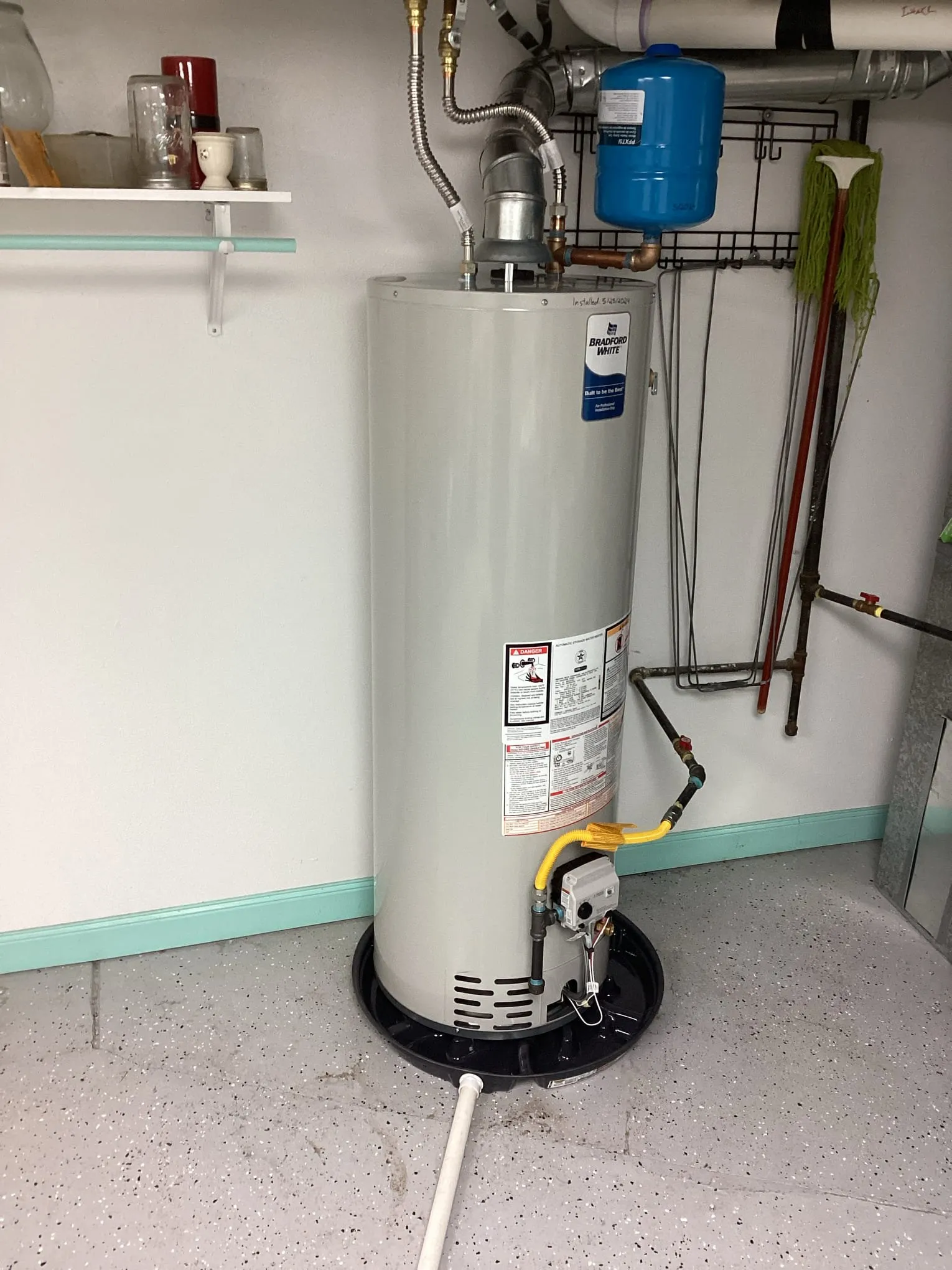
How long do water heaters last? Most tank water heaters last about 8 to 15 years, and tankless units last longer. Where yours lands depends a great deal on the anode rod, a metal rod inside the tank that corrodes so the tank doesn't. Checking it yearly is the simplest way to reach the long end.
Most tank water heaters last somewhere between 8 and 15 years. Fix-it 24/7's water heater page puts Charleston-area tanks at 8 to 12 years and tankless units at 15 to 20. DOE's guidance says storage water heaters last 10 to 15 years and most tankless models last more than 20.
That's a wide range. Water heater lifespan depends on fuel type, use, maintenance, water quality and the heater itself, according to Bradford White. A water heater's expected life comes down to a few things a homeowner can control:
The anode rod is the one most homeowners haven't heard of.
The anode rod is a sacrificial metal rod that protects the steel tank from rust. It's made of aluminum, magnesium or a combination, and it's designed to corrode over time instead of the tank.
A tank is steel with a glass lining, and the lining always has tiny gaps. The anode is a more reactive metal, so corrosion attacks the rod instead of the steel showing through those gaps. As long as there's rod left, the tank is protected. Once the rod is gone, the water starts on the tank itself, and a rusted-through tank can't be repaired. That's why one small part, and a yearly check of it, can decide whether a heater lasts 8 years or 15.
Check the anode rod once a year, and replace it based on what the check shows. Bosch recommends checking at least yearly and replacing about every two years, and more often where water is particularly aggressive. One manufacturer's manual says to replace it once more than 6 inches of the steel core wire shows. A yearly check tells you which rule fits your tank.
Bosch also says it won't cover damage caused by neglected anode maintenance, so it's worth checking what your heater's maker requires.
Flushing removes the sediment that settles on the bottom of the tank. Over time that layer takes up space, insulates the water from the burner or lower element, and makes the heater work harder for the same hot water. Popping, banging or rumbling sounds are the usual sign it's building up.
A flush and an anode check fit naturally into the same visit. The water has to be drained partway for both, so a plumber can look at the rod, clear the sediment and test the temperature and pressure relief valve at once. Done yearly, those three steps give a tank its best chance at the long end of its range.
There's no local evidence that it does. Charleston Water System's 2026 reports show average total hardness of about 53 mg/L, and the U.S. Geological Survey classifies anything from 0 to 60 mg/L as soft. Soft water leaves less scale and sediment in a tank than hard water does.
Water softeners are a different story. One manufacturer's manual warns that artificially softened water uses up anode rods faster, and Bosch links a rotten-egg smell from the hot water to anode reactions, particularly in homes with softened water. If you have a softener, have the rod checked more often. If you're on Mount Pleasant Waterworks, a private well or another utility, your water may be different, so ask your plumber what they find in your tank.
The clearest signs are rusty hot water, water around the base of the tank and age. Here's what each one usually means:
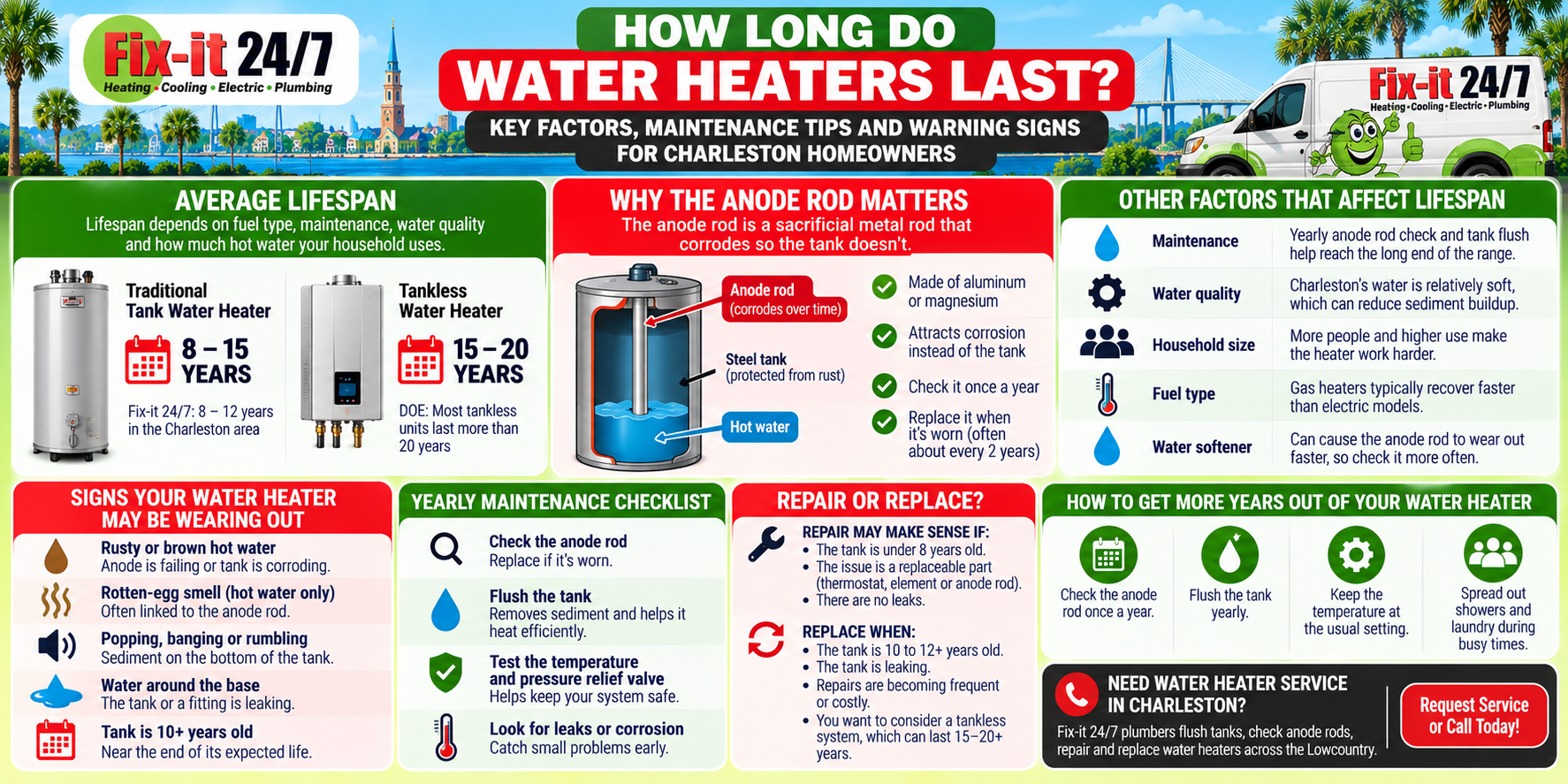
Find your heater's age on the label. Many manufacturers code the year into the first digits of the serial number.
One caution: a rotten-egg smell in the air around a gas water heater, not just in the hot water, can mean a gas leak. Leave the house and call your gas company or 911 from outside.
It's a job best left to a plumber. The water and the gas or electric supply have to be shut off, some water drained, and a rod that's been in place for years is often seized tight. Many tanks also need more overhead clearance than a closet or attic allows, and the relief valve and connections should be checked at the same time.
What you can do safely is keep an eye on the area around the heater, note the age, and call when you see any of the signs above. Fix-it 24/7's Green Club membership includes an annual water heater flush with an anode rod check and relief valve testing. The Hero Membership includes the same flush and is complimentary for firefighters, EMS, law enforcement and military, including veterans.
Repair usually makes sense for a tank under about 8 years old when the problem is a replaceable part like a thermostat, heating element or anode rod. Replacement makes more sense past 10 to 12 years, or when the tank itself is leaking.
If you're replacing, it's worth asking about a tankless system, which DOE says can last more than 20 years. Fix-it 24/7's earlier post gives five reasons to switch to a tankless water heater.
Replace it when a yearly check shows it badly worn, with the steel core wire showing. Bosch's general guide is about every two years, sooner with softened or aggressive water.
Rusty or brown hot water and a rotten-egg smell from the hot side are the common signs. The only sure way is to pull the rod and look at it.
It can wear the anode rod faster. Checking the rod more often, and replacing it when it's worn, protects the tank.
DOE says most tankless models last more than 20 years, and Fix-it 24/7's water heater page gives 15 to 20. Flushing on the manufacturer's schedule helps them get there.
Sometimes. A small repair on a tank with no leaks and a healthy anode can buy a few years. A leaking tank should be replaced.
Fix-it 24/7 plumbers flush tanks, check anode rods, test relief valves, and repair or replace water heaters across the Lowcountry, around the clock when it can't wait. Request water heater service online or call 843-305-8086.