
What size water heater do I need for a full house? Size it by its first hour rating, the gallons of hot water it can deliver in your busiest hour, rather than by tank size alone. If holiday guests are draining the tank, spacing out showers and laundry usually solves it until you know whether the heater is really too small.
The U.S. Department of Energy says to size a storage water heater by its first hour rating, which accounts for both the tank and how fast it heats. Your target is a rating at least as large as your household's busiest hour.
A good starting point comes from tank capacity. Fix-it 24/7's water heater page suggests roughly 40 gallons for one or two people, 50 gallons for two or three, and 75 to 80 gallons for families of four or more, and notes that Charleston's warm climate can allow slightly smaller tanks than colder places. Those numbers fit a normal week. A Thanksgiving week with three extra people is a different test.
Add up the hot water your house uses in its busiest hour. DOE's worksheet gives these averages:
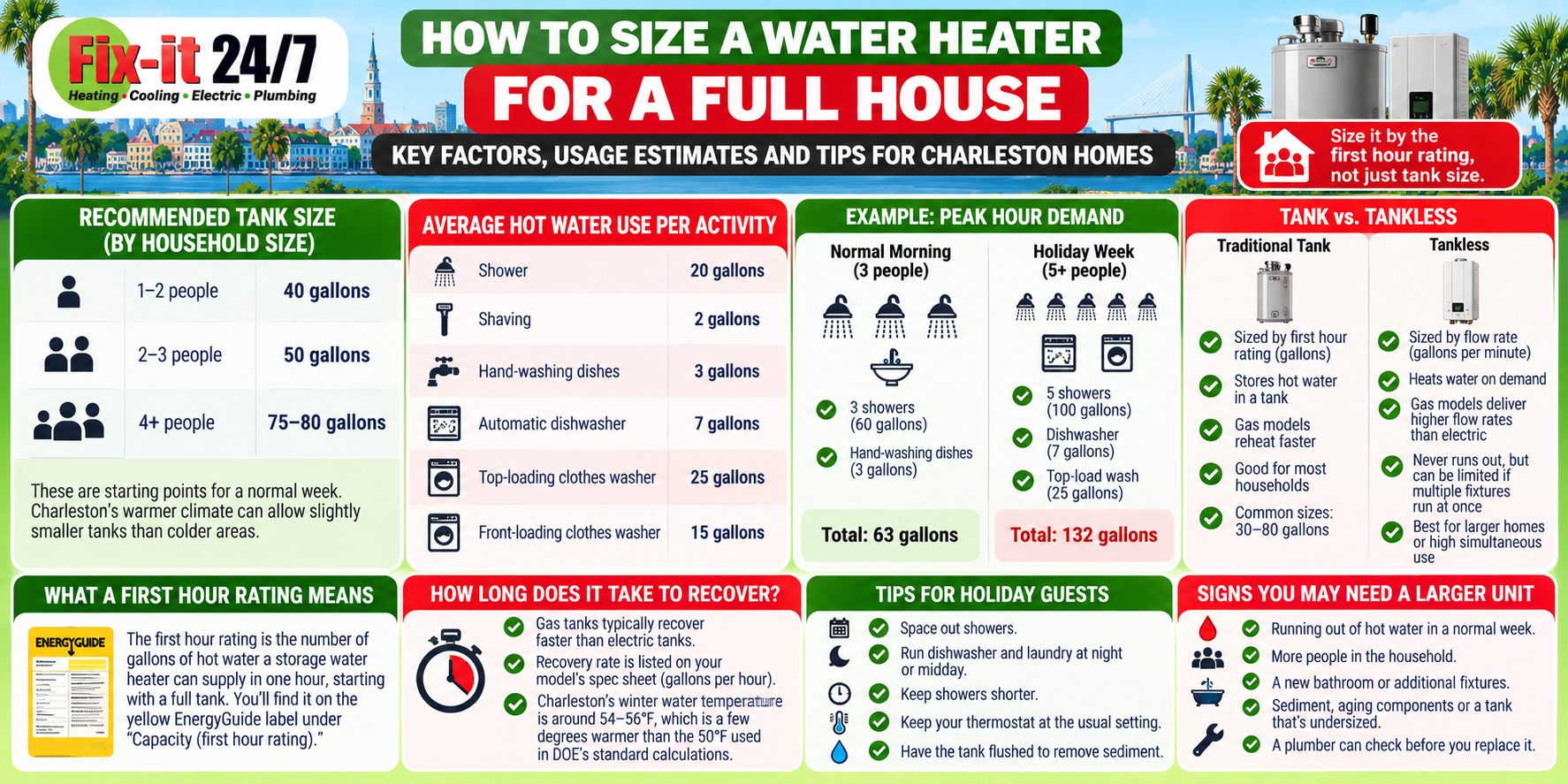
A normal morning for a family of three might be three showers and a sink of dishes, about 63 gallons. Now picture the Friday after Thanksgiving: five showers before everyone heads to the beach, a dishwasher load and a top-load wash, about 132 gallons. A tank that handles the first morning easily can run cold halfway through the second.
The first hour rating is the number of gallons of hot water a storage water heater can supply in one hour, starting with a full tank. It's measured with water leaving the tank at 125°F. You'll find it on the yellow EnergyGuide label, in the top left corner, listed as "Capacity (first hour rating)."
Two 50-gallon tanks can have different ratings. A gas heater with a larger burner, or an electric model with higher-wattage elements, reheats faster and earns a higher number.
Recovery is how quickly the heater brings incoming cold water back up to temperature after hot water is used. Gas burners put out more heat than electric elements, so gas tanks typically recover faster than electric ones. Manufacturers list the exact figure as a recovery rate, in gallons per hour at a stated temperature rise, on the model's spec sheet.
Charleston has a small advantage here. Charleston Water System's treated water averaged about 56°F in January 2026 and about 54°F in February. DOE's sizing guide assumes 50°F when you don't know your own, so on Charleston Water System a heater has a few degrees less work to do in winter than that default. Don't count on that to cover a houseful of guests, though. Back-to-back showers still empty a tank faster than any heater can refill it.
A tankless water heater is sized by flow rate in gallons per minute instead of gallons stored. DOE says most tankless units deliver 2 to 5 gallons per minute, with gas models producing higher flow rates than electric ones, and that a shower plus a dishwasher at the same time can push a unit to its limit.
To size one, add up the fixtures that run at once and the temperature rise you need. To get winter water from about 55°F to 120°F, you need a rise of about 65°F. A tankless unit never runs out the way a tank does, but it can only heat so many gallons per minute. For a holiday house, that means two showers at once may be fine while a third runs lukewarm. Fix-it 24/7's post on switching to tankless water heaters covers the trade-offs.
Spread out the demand before you consider a bigger tank. A few changes usually get a household through a busy week:
Fix-it 24/7's Green Club membership includes an annual water heater flush and priority scheduling, so sediment gets cleared every year instead of when the tank starts running short.
Running short in a normal week, not only at Thanksgiving, is the real sign. Running out of hot water quickly can come from sediment, failing components or a tank that's undersized for the house. A plumber can tell you which one it is before you replace anything.
If replacement makes sense, compare first hour ratings rather than tank sizes, and think about how your household is changing. A growing family, a new bathroom or relatives who visit often are all reasons to size up one step.
It can be, if its first hour rating covers your busiest hour. Fix-it 24/7's water heater page suggests 75 to 80 gallons for four or more as a starting point, but a 50-gallon tank with a high first hour rating can keep up with four people who stagger showers. If two or three people shower back to back every morning, size up.
It depends on the burner or element size and how much the water has to be heated. Gas tanks generally recover faster than electric ones. The recovery rate on your model's spec sheet, in gallons per hour at a stated rise, gives the real number.
Add up the gallons per minute of the fixtures you run at the same time, then choose a unit that delivers that flow at about a 65°F rise for a Charleston winter. Gas units handle higher flow than electric ones.
It's better not to. Hotter water raises the risk of scalding. Staggering showers and moving laundry and dishes to off-peak hours does more good.
Yes. An oversized tank keeps more water hot than you use, which costs more to run. Sizing by your real peak hour avoids paying for capacity you don't need.
Fix-it 24/7 plumbers install and repair tank water heaters from 30 to 80 gallons, tankless systems, and gas and electric models across Charleston, Berkeley and Dorchester counties. Learn more about water heater repair and installation, ask about financing options for a replacement, or call 843-305-8086.